
Turning a foam prototype into a production-ready drone
What do you do when your only reference is a foam model? No CAD. No drawings. Just a rough prototype made from polystyrene.
That was the brief from a client in the defence aerospace sector. They had the vision. But they needed a full set of production-ready files — and fast.
That’s where we came in.
Why a foam prototype creates real challenges
A foam prototype can spark ideas and help teams visualise a product — but it doesn’t give manufacturers what they need to move forward. Without proper design data, you’re stuck.
There’s no geometry to measure. No surfaces to reference. No tolerances to trust. Just a physical model with no digital footprint.
In sectors like aerospace and defence, that’s not enough. Parts need to be precise. Processes need to be repeatable. And timeframes rarely leave room for guesswork.
3D scanning is the bridge between idea and production
To get from foam to factory, we started with a high-precision 3D scan using our Creaform HandySCAN Black Elite.
This tool is designed for exactly this kind of job — capturing freeform, organic shapes that would be impossible to measure with traditional tools.
The drone had complex curves and no flat reference points. But the HandySCAN’s laser scanning tech handled it with ease.
Within hours, we had a clean, detailed mesh file — a full digital copy of the prototype down to the millimetre.
Think of it like turning a sculpture into a map. Every ridge, dip and contour is now visible in high resolution.
Why mesh data alone isn’t enough
This is where a lot of teams get stuck. A 3D scan gives you a mesh — essentially a dense web of triangles that represent the shape.
But meshes are messy. You can’t machine from them. You can’t design with them. You can’t run simulations or make adjustments without serious frustration.
We knew our client needed more than just a scan. They needed a usable, editable CAD model.
So we rebuilt the geometry from the ground up.
Reverse engineering creates usable CAD geometry
Reverse engineering means converting messy scan data into clean, structured surfaces. It’s a blend of science and craft — understanding both the part’s intent and its geometry.
Here’s how we did it:
- Imported the scan into our modelling environment
- Segmented the mesh into key surfaces and features
- Created reference geometry and aligned axes
- Rebuilt surface patches using NURBS modelling
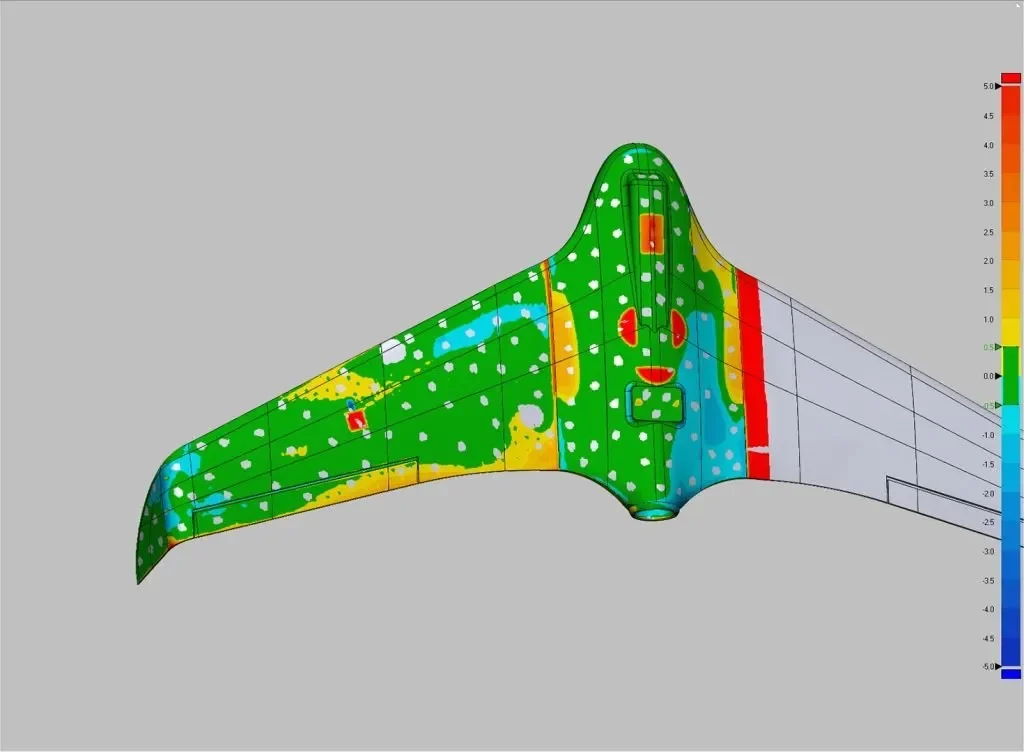
- Validated dimensions against the original scan
- Exported a clean, CAD-ready file
Now the model could be modified, simulated, and sent to production with confidence.
The result was more than a file - it was momentum
The end product wasn’t just a 3D model. It was a green light for development. Our client could now optimise the design, run airflow tests, adjust for payload, and start manufacturing.
We didn’t just scan a part. We solved a problem that was blocking progress.
That’s the kind of work we like to do.
What industries can benefit from this process
This isn’t just about drones. It’s about a mindset.
If you’ve ever held a prototype in your hands and wondered how to get it into production, this approach works across sectors:
- Electronics - where tiny details matter
- Marine - where no two surfaces are the same
- Motorsport - where speed means shaving off milliseconds
- Consumer products - where ergonomics and form matter as much as function
Reverse engineering bridges the gap between idea and production. And with the right team, that bridge can be short.
When is reverse engineering the right tool?
Here are four signs you should consider a scan-to-CAD workflow:
- You have a physical prototype but no design files
- The geometry is freeform or hard to measure
- You need to recreate a legacy part without drawings
- You want to speed up development from model to marketIt’s not about taking shortcuts.
It’s about removing dead ends.
Why our clients choose us for this kind of work
At Axiom, we’ve built a reputation for solving the hard problems. We operate in sectors where there’s no room for error - and no time to wait.
We invest in the tools, the training and the mindset to move quickly and accurately. Our HandySCAN is just one part of that picture.
But tools only go so far. It’s our team that makes the difference. Experienced. Detail-led. Obsessed with precision.
Key takeaway
Turning a foam prototype into a production-ready drone is completely possible - if you have the right process.
Scan with precision. Rebuild with care. Validate every step.
Then, you’re ready to fly.
Need to turn a prototype into production?
Whether it’s jigs, tooling, fixtures or full assemblies - we help teams move from stuck to solved.
Contact us to get started.